Széchenyi in the Snow: What Winter at the Bath Really Feels Like
Gábor on winter at Széchenyi: steam thick enough to lose a friend in, frosted hair over 38 degree water, the sprint from the door, and why December sells out.
 By Gábor Kovács, Budapest thermal bath specialist and spa experience guide
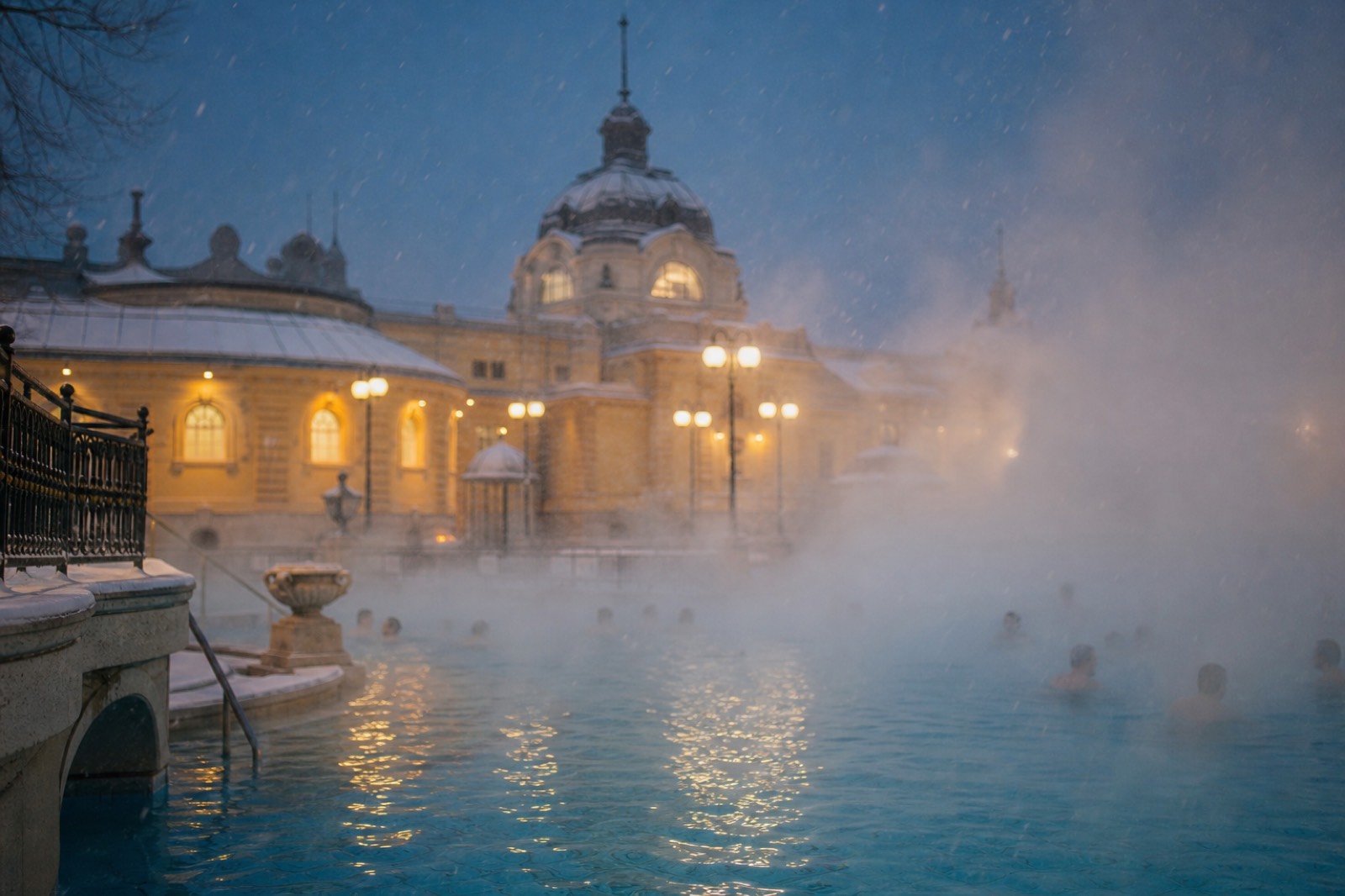
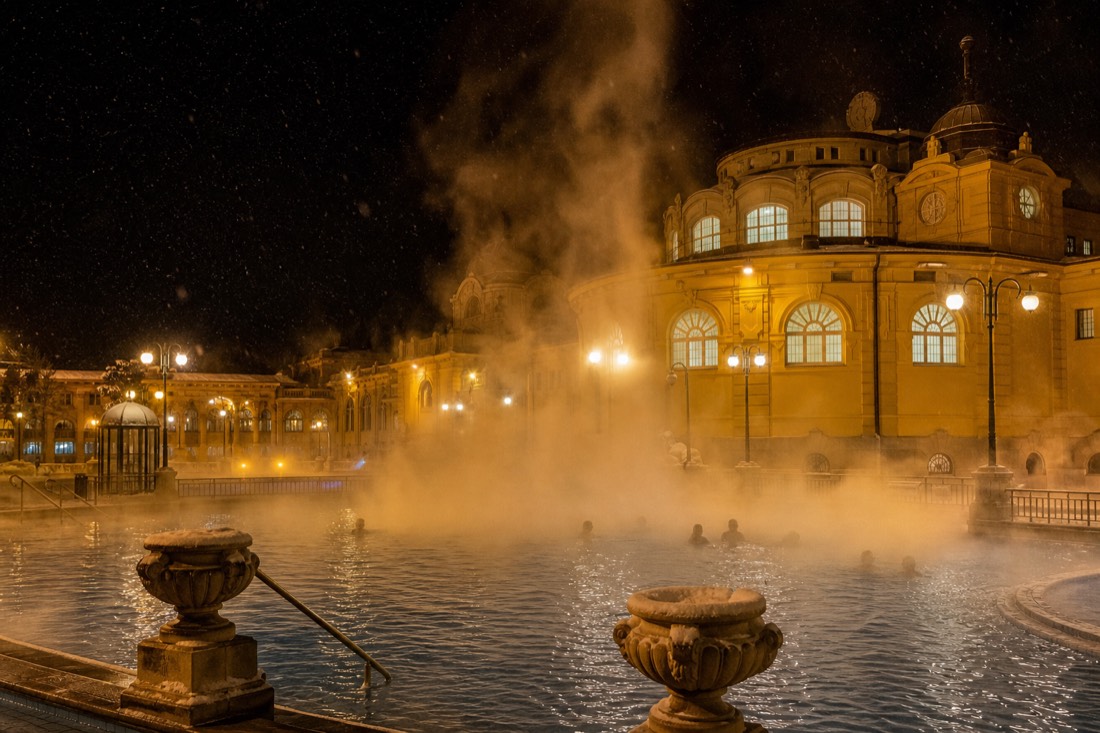
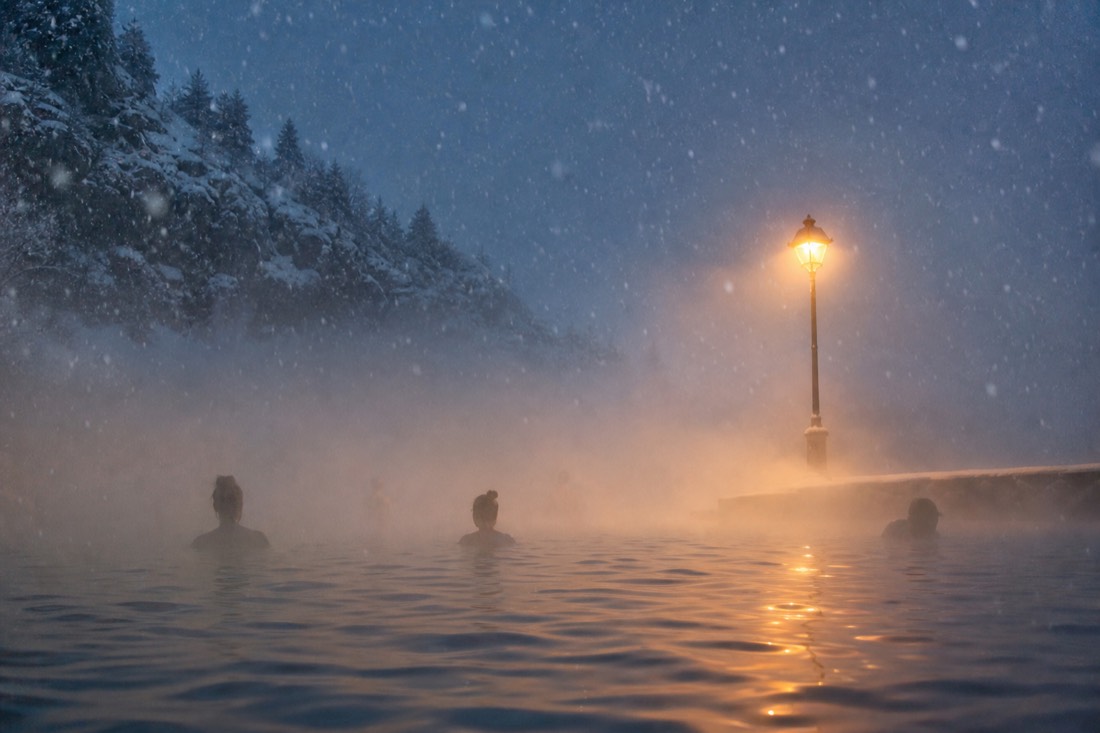
The first time it snows on a soak, everybody in the pool looks up at the same moment. I have watched that happen more winters than I can count now, and it never gets old: a few hundred strangers, chin-deep in water the temperature of a bath you would run at home, all staring at the sky like children. The flakes come down, hit the steam layer, and vanish a metre above your head. You never actually see snow land on the water. It just dissolves into the warm fog, and the fog is the whole show.
I take guests to Széchenyi all year, but if someone tells me they can only come once, I quietly hope their trip lands between December and February. Summer here is lovely. Winter is the point.
What does Széchenyi actually feel like when it snows?
Snow at Széchenyi means soaking in an outdoor pool held at 36 to 38 degrees while the air sits below freezing. Steam rises off the water in thick walls, your hair stiffens with frost, and your shoulders stay hot. It is the best version of the bath, and locals treat it that way.
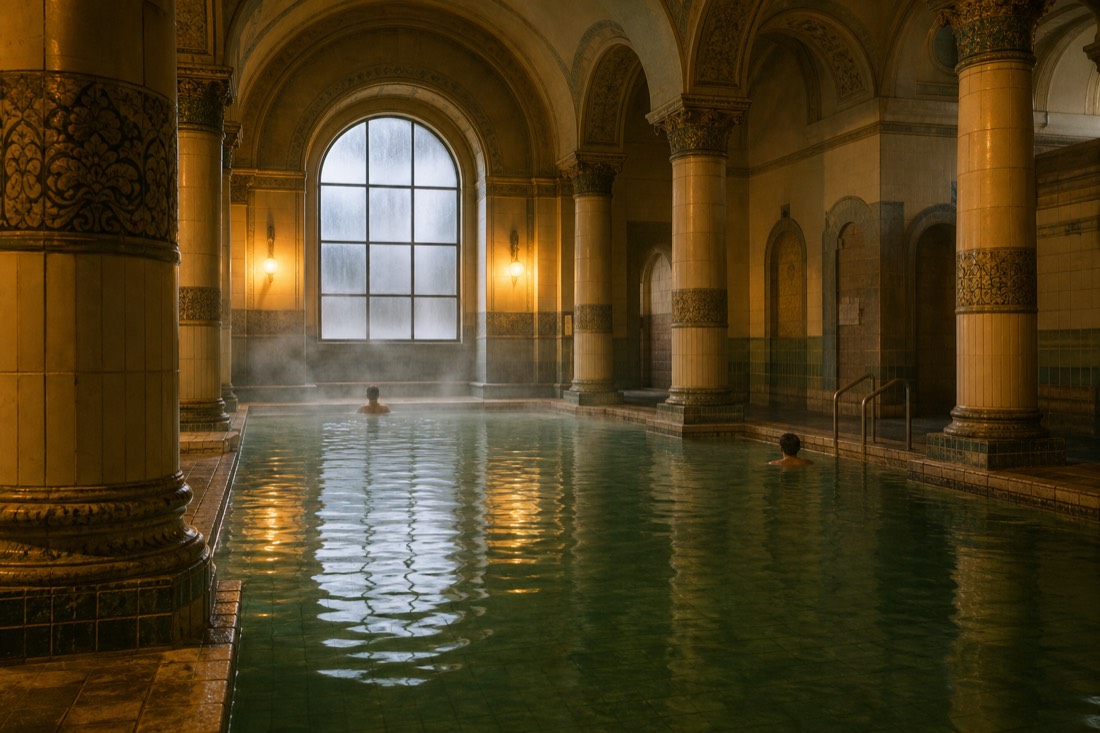
The steam is the first thing that rearranges your expectations. On a cold, still evening it gets dense enough that you genuinely lose people. I have turned to say something to a guest and found nobody there, then heard them laughing two metres away, invisible. You learn to keep a landmark: the yellow palace wall, a lamp, the corner where the chess players set up their boards on the water's edge and carry on as if the weather were a rumour.
Then there is the two-climates trick your body plays. Everything below the waterline is cooking gently at 36 to 38 degrees. Everything above it belongs to the Hungarian winter. Your shoulders steam. Your ears go pink. If your hair is wet and you stay out long enough, it frosts into stiff white strands, and every winter I watch someone discover this and grin like they have won something. In a way they have. That exact contrast, hot water and freezing air arguing over your body, is what people cross Europe for, and it simply does not exist in July.
How do you get from the changing hall to the water without freezing?
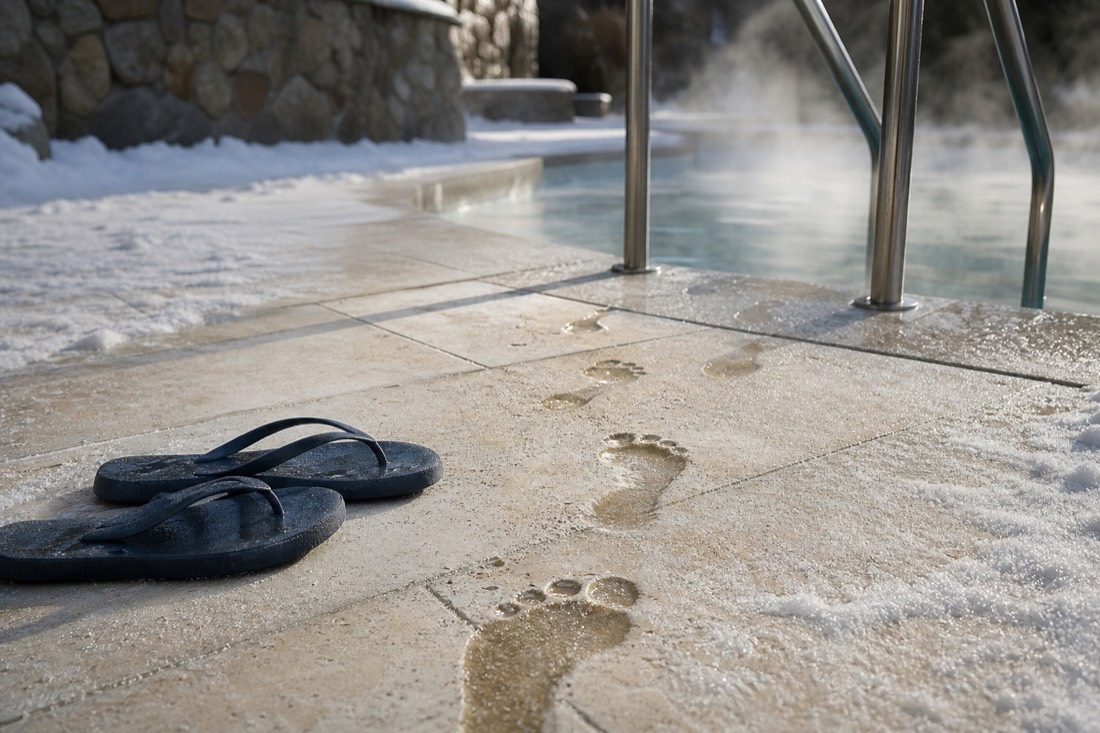
The walk is shorter than the internet makes it sound. Change indoors, route through the indoor pool halls, and use the doors nearest the outdoor thermal pool, so your skin meets winter air for only a few seconds. Flip-flops on your feet, towel on a hook inside, then commit and do not stop.
First-timers picture a long, heroic march across an icy courtyard in a swimsuit. The reality is kinder. The changing halls sit inside the building, the indoor medicinal section connects to them under one roof, and the exits closest to the big outdoor thermal pool put you a few strides from the steps. I tell my guests to treat it like ripping off a plaster: door, three or four fast steps, handrail, water. The gasp in between is part of the ritual.
The stones do hold the cold, though, which is why footwear matters more in January than in June. Flip-flops stay on until the last possible step. Your towel should not come outside with you at all; it will be a cold, damp rag by the time you want it. Leave it on a hook or in your cabin, and dry off indoors afterwards, not out by the pool.
Coming out is the half people forget to plan. My rule after many winters: decide where you are going before you leave the water. Stand up, out, straight back through the nearest door, no pausing to take photos with numb hands. Indoors, the warm air feels tropical within seconds, and that is the moment for the towel, not before.
Which pool order keeps you warm on a freezing day?
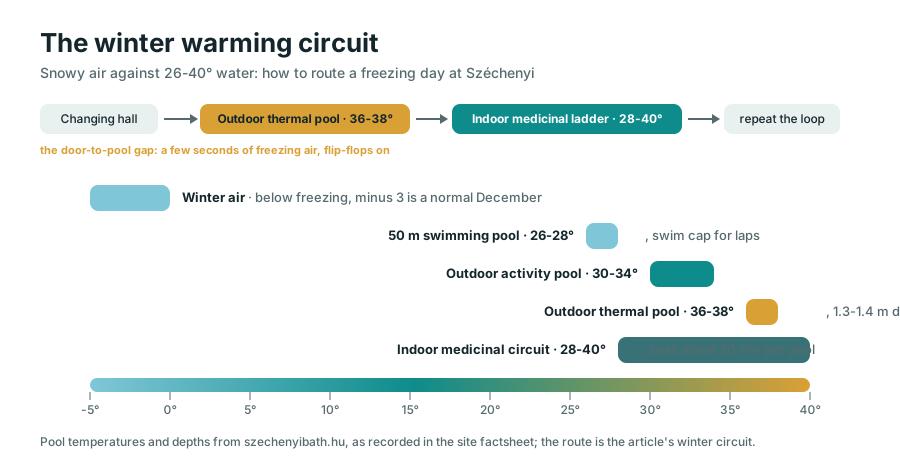
Start in the outdoor thermal pool, held at 36 to 38 degrees, and let it do the heavy lifting. When you need a change, move to the indoor medicinal circuit, which runs from 28 to 40 degrees, and treat each hot pool as a roughly 20 minute soak. Leave the 26 to 28 degree lap pool to swimmers.
Széchenyi in winter is really two experiences stitched together, and the order you take them in decides how the day feels. The outdoor thermal pool is the postcard and the furnace at once: 36 to 38 degrees, about 1.3 to 1.4 metres deep, warm enough that you can float there in a blizzard. The neighbouring outdoor leisure pool runs cooler at 30 to 34 degrees, which is glorious in August and a much shorter visit in January. The 50 metre outdoor swimming pool sits at 26 to 28 degrees and requires a swim cap for laps; in midwinter it belongs to a small, determined tribe I admire from a safe distance. The official pool list on szechenyibath.hu confirms those ranges if you want them from the source.
| Pool | Temperature | Where | Winter role |
|---|---|---|---|
| Thermal pool | 36-38°C, 1.3-1.4 m deep | Outdoor | The main event; snow overhead, furnace below |
| Activity / leisure pool | 30-34°C | Outdoor | Short playful visits; cools you faster than you expect |
| 50 m swimming pool | 26-28°C, swim cap for laps | Outdoor | Lap swimmers only; a cold plunge with extra steps |
| Medicinal pools | 28-40°C, soak about 20 minutes each | Indoor | The warming ladder between outdoor rounds |
The rhythm that works, round after round, is outdoor first while you are fresh, then the indoor circuit as a recovery lap. Indoors you climb the temperatures pool by pool, sit your rough 20 minutes in the hot ones, and head back out once your core is stocked with heat. I walked through that full indoor sequence in a full day at Széchenyi if you want the room-by-room version.
One practical note that matters more in winter than any other season: a cold-month soak is a full-day project, not a 90 minute stop, so the ticket should match. I point guests at the Széchenyi full-day pass, which covers entry with a locker or cabin for the whole day, and I tell them to check live availability and prices on GetYourGuide rather than gambling on the ticket window queue in the cold.
What should you pack for a winter soak?
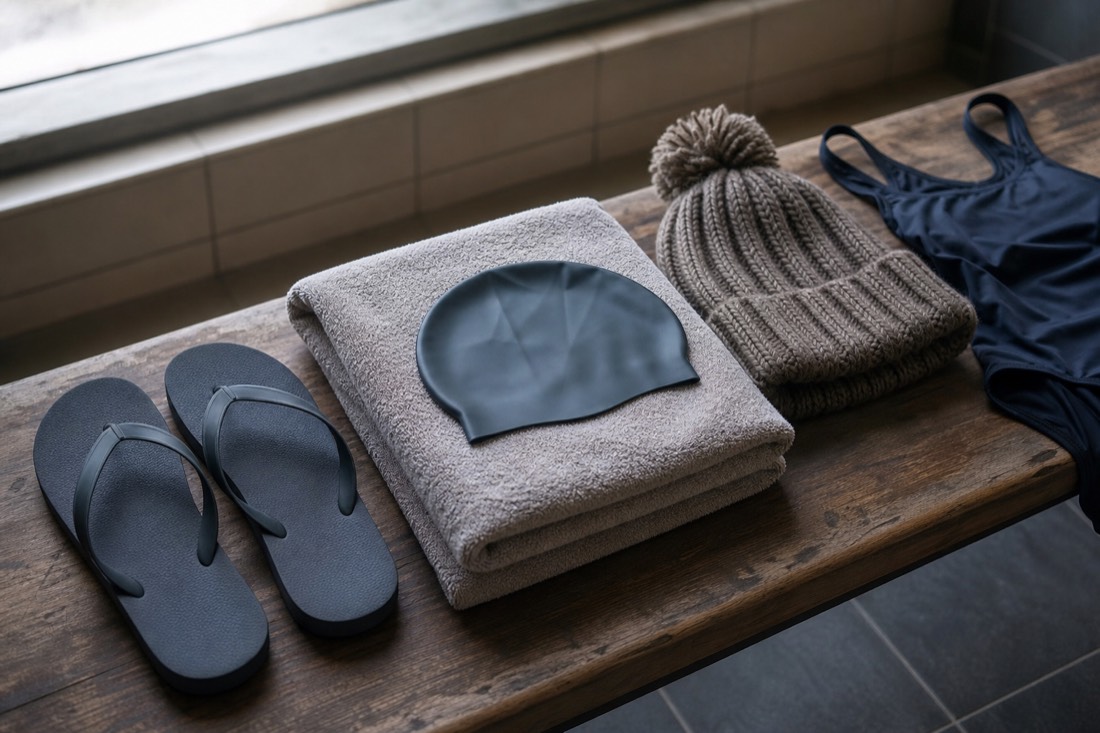
Bring flip-flops, your own towel, a warm hat for afterwards, a swim cap if you plan to swim laps, and a plastic bag for the wet kit. Guests who skip the flip-flops regret it within a minute; the stones between the door and the pool hold the cold.
The winter bag is only slightly different from the summer bag, but the items you forget punish you harder. Flip-flops turn from a comfort into near-essential kit. A dry hat becomes the single best thing you own, because you will walk back to the metro with damp hair through sub-zero air, and that walk decides how fondly you remember the evening. Reviewers on the day-pass listing repeat the same two lessons every season: bring your own towel and bring something for your feet.
| Item | Why it earns its place in winter | Notes |
|---|---|---|
| Flip-flops or sliders | Frozen stone and wet tile between door and pool | Keep them on to the last step |
| Own towel | Drying off fast indoors, before the frost finds you | Never leave it outside by the pool |
| Warm hat | Wet hair plus freezing air on the way home | The cheapest comfort upgrade there is |
| Swim cap | Required for laps in the 26-28°C swimming pool | Skip it if you are only soaking |
| Plastic bag | Soaked swimsuit and towel after checkout | Keeps the rest of your bag dry |
Groups have one more trick worth stealing. The full-day pass comes with a locker or a cabin, and travelling parties often book a single cabin as a shared base, then take cheaper lockers for the rest. Everyone gets a private place to change in turns, and the coats, boots and scarves of four people live in one dry room instead of four cramped lockers. In December, when everybody arrives wearing half their wardrobe, that cabin earns its keep by mid-afternoon.
On what actually goes on your body, and the small unwritten rules around it, I keep a separate guide to what to wear and bath etiquette; the short version is that a normal swimsuit is right, nudity is not a thing here, and nobody will look at you twice for wearing a wool hat in the water. Locals do it all winter.
Why do locals treat December as the real season?
Because winter is when the contrast works. December and January bring the coldest air, the thickest steam, and the biggest demand, so the full-day pass regularly carries a likely to sell out flag. Book a day or two ahead; cancellation is free up to 24 hours before.
There is a persistent idea that thermal baths are a summer activity, and every local I know finds it gently funny. A 38 degree pool in a 30 degree August is pleasant. The same pool in a minus 3 December is theatre. The steam doubles, the frost appears, the palace glows against a dark sky by late afternoon, and the whole experience becomes the thing the photographs promised. That is why the cold months are the busy months, not the quiet ones, and why I tell people to book the pass before they fly rather than after they land.
The timetable rewards a little planning too. Doors open at 07:00 on weekdays, and the quietest, most private version of the bath I know is that first winter hour, when the sky is still black and the steam is thickest. At the other end of the week sits my favourite oddity: Friday is the one day the bath runs to 22:00 instead of 20:00, which in December means up to six hours of proper night soaking under the lamps. Most visitors never notice, because Saturday steals the late-night attention with Sparty, the separate 18+ party that takes over on Saturday nights.
| Day | Hours | Winter angle |
|---|---|---|
| Mon-Thu | 07:00-20:00 | 07:00 starts in the dark; the calmest steam of the week |
| Friday | 07:00-22:00 | The long night window; the bath after dark without a party ticket |
| Sat-Sun | 08:00-20:00 | Busiest days; Saturday night hands the pools to Sparty |
Two booking realities are worth naming plainly. First, Gellért is closed for renovation until a planned 2028 reopening, so the winter demand that used to split across the river now lands heavily on City Park. Second, families should know the limits before buying: the day pass does not admit children under 14, and the Budapest baths themselves keep under-14s out of the medicinal pools. For the wider seasonal picture, month by month, water by water, my structured winter baths guide does the comparing; this post is just what the snow feels like from inside the steam.
If your trip lands in the cold months, I envy you slightly. Book the pass, pack the hat, take the Friday night if you can get it, and when the first flakes hit the steam, look up with everyone else.